Beautiful Wreckage: How Broken Audio Files Became a Composer's Best Instrument
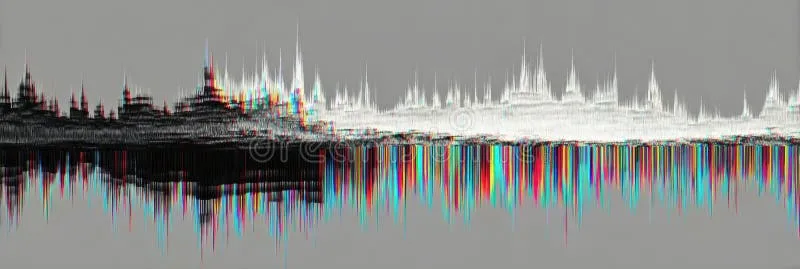
Photo: audio waveform glitch digital corruption sound studio producer, via thumbs.dreamstime.com
At some point, a file gets corrupted. Maybe it's a download that stalled out halfway. Maybe it's a field recording stored on a failing hard drive. Maybe it's an audio file that got run through the wrong codec, opened by incompatible software, or simply sat on a damaged disk long enough to start deteriorating at the bit level.
For most people, that's the end of the story. Trash. Error. Try again.
For a scattered but serious community of producers and composers, that's exactly where the interesting part starts.
The Sound of Something Breaking
There's a specific quality to corrupted audio that's hard to describe if you haven't heard it. It's not just noise. It's noise with structure — strange rhythmic stutters, harmonic artifacts that shouldn't mathematically exist, tones that slide through pitches no synthesizer was programmed to produce. A corrupted MP3 doesn't sound like static. It sounds like something trying very hard to be music and not quite making it, which turns out to be its own kind of music.
Producers working in this space — loosely grouped under terms like glitch, databending, or circuit aesthetics — have been exploring corrupted audio for years. But something has shifted recently. What was once a niche experimental practice has started bleeding into wider underground music production communities, particularly in the spaces where ambient, noise, and left-field electronic music overlap.
Kaito Brennan, a producer based in Seattle who releases music under the handle Salted Sector, has built his entire catalog around what he calls "found damage." He trawls corrupted downloads, intentionally opens audio files in text editors and scrambles the data, and records the output of failing playback hardware. His releases — distributed on Bandcamp and occasionally pressed to short-run cassettes — have accumulated a dedicated following that seems to genuinely understand what they're listening to.
"There's a grammar to how files break," he explains. "Different codecs fail in different ways. An MP3 glitches differently than a FLAC. WAV corruption has its own character. Once you start hearing those patterns, you can't unhear them. You start treating the failure as a voice."
Databending and the Accident as Method
The technical practice here is worth understanding, because it's more intentional than it might sound. Databending — the act of deliberately corrupting a file by manipulating its raw data — has roots in visual glitch art, where artists open image files in audio editing software, apply effects meant for sound, and save the result as an image. The same logic applies in reverse: open an audio file as raw text or hexadecimal data, make changes the file format wasn't designed to accommodate, and play back whatever survives.
The results are genuinely unpredictable. That unpredictability is the point.
Naomi Vásquez, a composer and sound designer in Los Angeles, approaches the practice from a more academic angle. She's been documenting her process in a semi-regular newsletter that reads like field notes from an audio archaeologist. "I think of it as a collaboration with a system I don't fully control," she writes in one entry. "I make a decision, the file makes a decision, and we meet somewhere in the middle. That negotiation is the composition."
Her work has been featured in installation contexts — sound pieces where the corruption is visible as well as audible, where audiences can see the waveform's jagged impossible shapes while they listen. The effect is disorienting in a way that feels earned rather than gimmicky.
Transmission Errors as Raw Material
Not everyone in this space works with intentionally corrupted files. Some producers focus specifically on transmission error — audio that was damaged in transit, whether through degraded streaming, interrupted broadcasts, or the long-distance distortion of shortwave radio signals.
This is where the practice gets almost archival. There's a small community of producers who record shortwave broadcasts specifically to capture the interference, fading, and signal bleed that comes with long-distance transmission. The music underneath barely matters. What they're after is the texture of the journey the signal took to reach them — the atmosphere it passed through, the interference it picked up along the way.
One producer, who goes by the name Vessel Static and operates out of Minneapolis, has released several albums built entirely from shortwave recordings made during solar weather events, when geomagnetic activity creates particularly chaotic signal conditions. The resulting audio — layers of warbling interference, ghost voices from distant stations bleeding through each other, tones that drift and collapse — is haunting in a way that's hard to categorize.
"I'm not composing," he says flatly. "I'm editing. The ionosphere is composing. I'm just deciding what to keep."
Why Failure Sounds Like Truth
There's a philosophical undercurrent to all of this that's worth sitting with. Digital audio, in its ideal state, is perfect reproduction — a lossless copy of a sound, indistinguishable from the original, preserved indefinitely. That's the promise of the format.
But that perfection comes with a kind of sterility. A perfectly reproduced sound has no history. It doesn't carry the evidence of where it's been or what it's been through. It sounds exactly the same on playback number ten thousand as it did on playback number one.
Corrupted audio is the opposite. It carries its damage visibly, audibly, structurally. You can hear exactly where the file broke down, where the codec gave up, where the signal lost coherence. That damage is a record — a strange, unintentional autobiography of a file's life and deterioration.
For producers working in this space, that's not a problem to solve. It's the signal they've been looking for.
The internet generates failure constantly — broken downloads, degraded streams, corrupted transfers, files that arrive damaged and unplayable. Most of that failure disappears quietly, unheard, sent to the recycle bin. But somewhere in a Seattle apartment, someone is recording it. Somewhere in Minneapolis, someone is building a whole album out of the noise the sky makes when the sun misbehaves.
The wreckage is out there. And it sounds, if you know how to listen, surprisingly alive.