When Broken Pixels Started Asking Real Questions: The Accidental Philosophy of Glitch Art
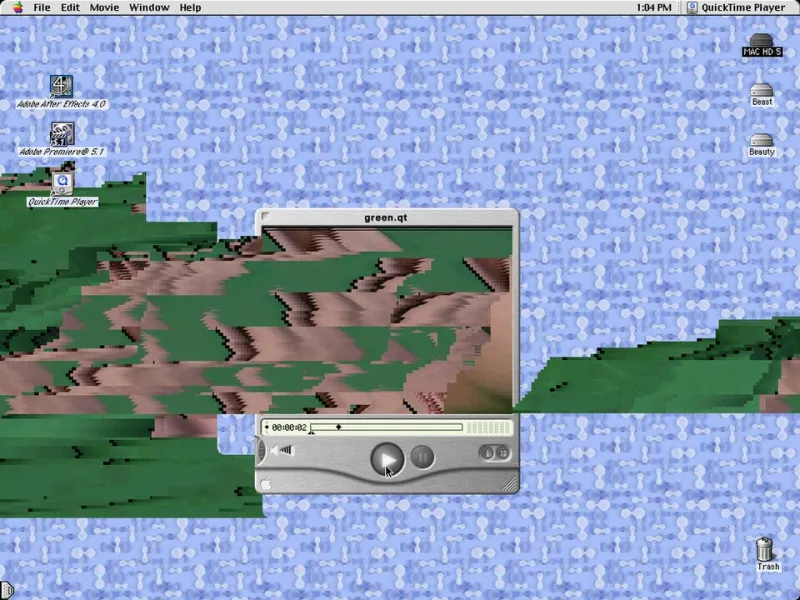
Photo: jonCates, CC BY-SA 4.0, via Wikimedia Commons
Nobody sits down to make glitch art expecting an existential crisis. You open a JPEG in a text editor, delete a few lines of data, save it back, and suddenly you're staring at something that looks like a fever dream painted by a machine that doesn't know it's dreaming. The colors bleed wrong. Faces fracture into geometric noise. And somewhere in the back of your head, a small, annoying voice starts asking: wait, is this what the image always was?
That voice is the whole point.
The Accident That Started Everything
Glitch art as a deliberate practice has been floating around underground creative communities since at least the early 1990s, but it really found its footing in the 2000s when digital tools became cheap enough for anyone to experiment with. Artists like Cory Arcangel and Rosa Menkman weren't just making weird visuals for shock value — they were interrogating the systems themselves. What happens when you force a machine to do something it wasn't designed to do? What does it reveal about what it was hiding?
Menkman, whose 2011 Glitch Moment/ums is basically the foundational text of the movement, described glitch not as failure but as a moment of noise — a disruption that exposes the invisible grammar underneath clean, polished output. Every smooth image you've ever seen on a screen is actually a set of instructions, a compressed agreement between software and hardware about what reality is supposed to look like. Glitch breaks that agreement. And what leaks out is something much stranger than the original.
This isn't just aesthetics. This is, whether the artists intended it or not, philosophy.
What Plato Would Have Made of Datamoshing
Here's a technique called datamoshing: you take video footage and deliberately remove the frames that tell the codec where objects are in space. What you get is motion data applied to the wrong images — a person's running legs bleeding into a landscape, a face melting into architecture. It looks surreal. It also looks, uncomfortably, like how memory actually works.
Neuroscientists have been pointing out for decades that human perception is less like a camera and more like a very confident guesser. Your brain receives incomplete sensory data and fills in the gaps using expectation, pattern recognition, and prior experience. You don't see the world — you construct a version of it that's good enough to navigate. Datamoshing does the same thing, just badly. It applies the wrong prediction to the wrong input and produces something that is technically coherent but obviously wrong.
So which version is the glitch — the datamoshed video, or the story your brain tells you every waking second?
Plato's allegory of the cave has been referenced so many times it's practically a meme at this point, but it fits here in a way that feels genuinely uncomfortable. The prisoners in the cave mistake shadows for reality because shadows are all they've ever known. Digital compression artifacts, corrupted renders, and failed algorithms are, in a weird way, the shadows becoming visible. They remind you that the clean image was always a shadow too.
The Hidden Layers Problem
One of the more quietly radical things glitch artists discovered is that digital systems have layers most users never see and never think about. When you view a photograph on your phone, you're not seeing the photograph. You're seeing the end result of a chain of encoding decisions, compression algorithms, color space conversions, and display calibrations — all of which are invisible and all of which shape what you perceive as real.
Breaking those layers makes them visible. It's the same reason you only notice your own heartbeat when something goes wrong with it.
This has real implications beyond art. We live inside digital systems constantly now — social media feeds, navigation apps, recommendation algorithms, filtered camera lenses that smooth skin and brighten eyes before you even choose to post. These systems are making billions of micro-decisions about what reality looks like, and they're doing it so smoothly that most people never notice. Glitch art, at its best, is a refusal to let that smoothness go unexamined.
Artist Sabato Visconti, whose glitched portraits have circulated widely online, has talked about how corrupting an image of a face forces viewers to reckon with how much of their emotional response to a face is constructed rather than received. You feel something when you see a human face. When that face starts fragmenting into abstract data, the feeling doesn't disappear — it gets weird and uncomfortable. That discomfort is information.
Noise as Signal
There's a term in information theory — signal-to-noise ratio — that describes how much useful information exists in a transmission relative to random interference. The goal of most communication technology is to maximize signal and minimize noise. Clean image, clear sound, no artifacts.
Glitch artists have been arguing, implicitly and sometimes explicitly, that noise is signal. That the interference isn't a problem to be solved but a message being sent. About the system. About perception. About the gap between what we're shown and what is actually there.
This is, depending on your philosophical orientation, either deeply comforting or deeply unsettling. If the glitch reveals something true, then the polished version was concealing something. And if the polished version was concealing something, then every clean, smooth, optimized surface in your daily life is doing the same.
Your Instagram feed. Your GPS. The camera that takes your driver's license photo. All of them are making choices about what reality looks like, and none of them are asking your permission.
The Signal Worth Chasing
What makes glitch art genuinely interesting — and genuinely philosophical — isn't that it's transgressive or weird or aesthetically provocative, though it's all of those things. It's that it stumbled onto something real by breaking something artificial. The artists who started corrupting files in the early 2000s weren't reading Descartes or Baudrillard (well, some of them were reading Baudrillard, it was that kind of scene). They were just curious about what happened when you pushed a system past its limits.
What happened was that the system told the truth.
Not the truth it was designed to tell — the truth underneath that one. The truth about compression and assumption and the incredible amount of work that goes into making the digital world feel seamless and natural and real.
Next time an image fails to load and you see a smear of wrong colors where a face should be, don't scroll past it immediately. Sit with it for a second. That's the machine showing you its skeleton. That's the signal underneath the signal.
It's strange. It's uncomfortable. And it might be the most honest thing your phone has ever shown you.