Fuzz and Feeling: The Young Creators Who Chose Tape Over the Cloud
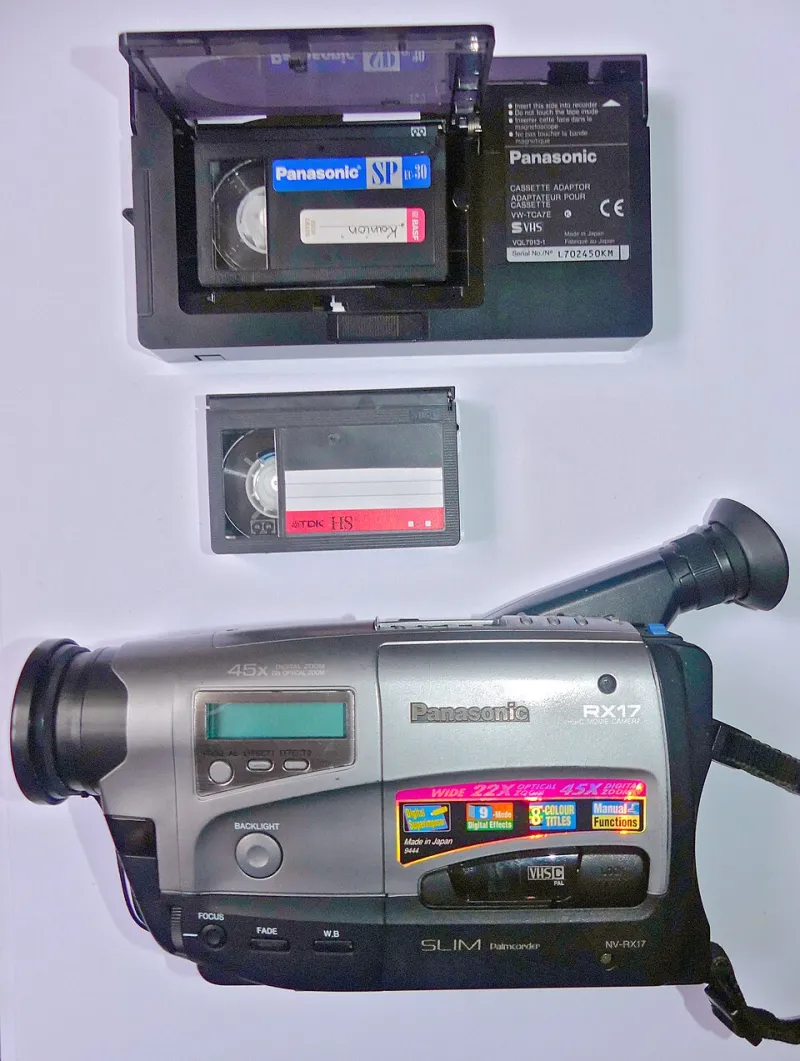
Photo: Zalasem1, CC BY 4.0, via Wikimedia Commons
There's a specific kind of visual static that lives in the corner of a VHS recording — a soft, electric shimmer that no Instagram filter has ever quite replicated. It flickers. It bleeds color at the edges. It reminds you that something real happened in front of a real lens, and that time has physically touched the evidence.
For a surprising number of younger creators in 2024, that shimmer isn't a flaw. It's the entire reason they're shooting on tape.
The Machine That Refuses to Be Perfect
Walk through any decent thrift store in Portland, Austin, or Brooklyn right now and you'll find the camcorders lined up like relics waiting to be reclaimed. Panasonic PV-series units. JVC GR models. The occasional Sony Handycam still wearing a cracked wrist strap. They're priced between eight and thirty dollars, and people are buying them — not to resell, but to use.
Mia Castillo, a 29-year-old video artist based in Chicago, has been shooting exclusively on VHS for three years. Her work — short, looping pieces that document mundane domestic life — gets screened at small gallery shows and occasionally shared online as compressed digital transfers. But the originals live on tape, stacked in labeled cases on a shelf in her apartment.
"Digital keeps everything perfectly," she says. "Which sounds great until you realize that perfection kind of erases the feeling that time passed at all. Tape degrades. It's honest about being old. I want my work to age."
That desire — to let something age, to invite impermanence into the creative process — is showing up across the country in ways that feel less like a trend and more like a quiet philosophical stance.
Rejecting the Algorithm's Aesthetic
It's worth being direct about what these creators are pushing back against. Algorithmic content platforms have, over the past decade, gradually trained audiences toward a particular visual language: crisp resolution, stabilized footage, color-graded consistency, immediate accessibility. Everything optimized for a five-inch screen and a two-second scroll.
VHS is the structural opposite of that. The format is physically incapable of delivering what the algorithm rewards. A tape shot in a dim kitchen is going to look like a fever dream — color noise, tracking artifacts, audio that sounds like it's being filtered through a wool blanket. You can't fix it in post. You can't run it through a preset. The camera decides what it can capture, and you work with what you get.
For some creators, that constraint is the liberation.
Derrick Osei, a 32-year-old filmmaker in Atlanta, started using a VHS camcorder to document his neighborhood after years of shooting on a mirrorless digital camera. "I was spending more time in editing than I was actually out filming," he says. "With tape, I go out, I shoot, I come back. What's on the tape is the film. There's no version two."
His short documentary work — neighborhood portraits, street scenes, conversations shot through living room windows — carries a weight that he attributes directly to the format. "People act differently when they see that camera," he adds. "It's not threatening. It looks like someone's dad is filming a birthday party. They relax."
The Distribution Question
Here's where it gets genuinely interesting: some of these creators aren't just shooting on tape. They're distributing on tape.
Small-run VHS releases — sometimes as few as twenty or thirty copies — have become a real, if niche, distribution format for experimental short films, music videos, and zine-adjacent video art. Labels like Vulcan Video (Austin) and various regional micro-distributors have been pressing limited tape runs for underground filmmakers who want their work to exist as physical objects with finite lives.
A VHS copy wears out. It degrades with each playback. The fiftieth person to watch a tape is seeing a different artifact than the first person did. That's not a bug these creators are trying to patch. It's the whole architecture of the thing.
"I made thirty copies of my last piece," says Castillo. "When those tapes are gone, they're gone. I'm not putting it on Vimeo. I want people to know they're holding something that won't exist forever."
Analog as Signal
There's a signal buried inside all of this that goes beyond aesthetics. What these creators are really doing is making a statement about memory, documentation, and what it means to leave a record.
The internet promised permanence — everything saved, everything searchable, everything backed up across redundant servers somewhere in Nevada. And yet platforms disappear. Accounts get suspended. Algorithms bury content so thoroughly it might as well not exist. The permanence turned out to be conditional, corporate, and fragile in ways nobody fully anticipated.
Tape is also fragile. But it's fragile on your terms. It sits on your shelf. It degrades on its own timeline. Nobody can delete it with a policy update.
For a generation that grew up watching MySpace pages vanish overnight and Instagram accounts shadowbanned into oblivion, there's something almost radical about that. The fuzz isn't just aesthetic. It's a frequency — a signal that says: this happened, it was real, and I kept it myself.
The cameras are cheap. The tapes are everywhere. And somewhere in a Chicago apartment, a shelf of labeled cassettes is quietly aging into something that no algorithm will ever fully understand.